


Voting Resources
The Best Little Borderhouse in Texas
Washington is about to reimburse Texas $7.5 billion for a program that never defined success. American taxpayers will be footing the bill for the Texas’ political theater.
 This article was authored by Loren Steffy:
America, welcome to the Texas Border Follies. You’re paying for it now.
Sen. John Cornyn told the Texas Tribune recently that Texas will collect at least $7.5 billion from a federal border reimbursement fund — three-quarters of the $10 billion Congress made available to all 50 states. The money was authorized in July 2025 as part of the One Big Beautiful Bill Act. Gov. Greg Abbott and Homeland Security Secretary Markwayne Mullin settled on the number in a negotiation about a month ago.
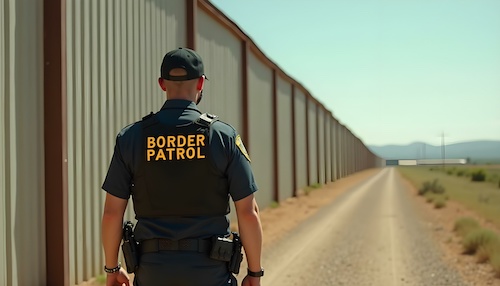
What the money buys, retroactively, is Operation Lone Star — Abbott’s $11 billion border boondoggle, launched in March 2021, which paid for National Guard deployments, state troopers, wall segments, floating buoys in the Rio Grande and migrant prosecutions.
The house Abbott built
The state has been running the Best Little Borderhouse in Texas — a place where the money flows, the politicians have a good time spending it, and no one asks too many questions.
The Chicken Ranch in La Grange operated for a century with the quiet consent of pretty much everyone until Houston television reporter Marvin Zindler made it politically impossible to keep pretending. In the musical based on it, the best number belongs to the governor of Texas, who responds to the scandal with a song about “doing a little two-step” a sideways shuffle in which he manages to commit to absolutely nothing.
Five years into Operation Lone Star, no reporter has managed the Zindler ending. The two-step remains an effective gubernatorial dodge.
A few years ago, in an op/ed for the Houston Chronicle, I estimated that Operation Lone Star cost about $435,000 for each of the 23,000 migrants it stopped in its first three years. That figure doesn’t count anyone who got through, which is the number that would actually tell you whether the thing worked.
Despite its high cost, no one can call Operation Lone Star a failure, because Abbott never defined success.
Operation Wetback, the 1954 federal deportation campaign, at least had a stated objective and fell short of it. Operation Lone Star solved that problem by never setting one. It had no target number of crossings prevented, no goals for apprehensions or arrests, no benchmark, no metric that could later be checked against a result. Eleven billion dollars, five years and no yardstick — all backed by leaders who purport to be fiscal conservatives.
The books, such as they are
In 2022, the Texas Tribune found that more than 2,000 criminal charges had to be stripped out of Operation Lone Star’s own statistics because they had nothing to do with the border. They included some 270 violent offenses such as cockfighting, stalking and sexual assault. One man was arrested for a family violence charge in Midland, 250 miles from the Rio Grande, and counted toward border security.
In July 2021, the Department of Public Safety widened its reporting zone to 63 counties — an area, as the Tribune put it, almost the size of Oregon — which conveniently swept in work already being done by troopers who were there anyway.
Abbott’s office also touted the seizure of 887 pounds of fentanyl, a quantity helpfully defined as “more than 201 million deadly doses.” Only about 160 pounds were actually seized in DPS’s designated operational areas, most of it in El Paso County, which wasn’t getting Operation Lone Star resources.
Patrick O’Burke, a former DPS commander, said counting unrelated arrests “misrepresents the accomplishments” and called the approach “inherently flawed.” Gary Hale, who ran DEA intelligence in Houston, was blunter: “We really haven’t had any significant impact on migrant smuggling or drug trafficking.”
Congress shouldn’t send a dime without a Government Accountability Office audit, but that won’t happen. Accountability was never the point. It was all about the show, which goes on no matter what.
The honest case for paying
Border security is a federal responsibility. For four years, Texas took the position that Washington wasn’t meeting it and spent state money on a federal job. If you accept that premise — and a lot of Texans do — then reimbursement isn’t a windfall. It’s a state getting paid back for covering someone else’s job. Cornyn has made that case, and he’s plainly irritated at how long DHS has taken to cut the check. “It’s a little maddening to feel like you’re pulling teeth,” he told the Tribune.
But reimbursement without evaluation and accountability is just a slush fund. Federal taxpayers deserve to know what they got — or didn’t get. But now, the money is flowing, no questions asked. After all, what’s a few billion among political chums, especially when, as Cornyn noted, the midterms are just two months away.
We can anticipate the next act. The Border Follies will go on the road, far beyond Texas. Every governor watching our Lone Star Grift sees that they, too, can spend state money on immigration enforcement, forego stated objectives, produce a little political theater — a few National Guard troops, some concertina wire, a few fluorescent river floaties — and send Washington the bill.
What $7.5 billion doesn’t buy
But the money won’t change the larger costs of Abbott’s enforcement-only mindset.
Net international migration to Texas fell to 167,000 in 2025 from nearly 355,000 the year before, according to the Dallas Fed — a collapse of more than half in a single year. Texas payrolls grew one-tenth of one percent over those twelve months. In a state that has spent twenty years outrunning the national economy, that is statistically indistinguishable from standing still. Dallas Fed economists pointed at policy uncertainty, tariffs and drastically lower immigration.
The Texas Miracle was never about the tax rate or lax regulation, despite what Abbott likes to say. It was the labor supply. Since 2020 the state added 2.6 million residents, 2 million payroll jobs and nearly half a trillion dollars in output, and the driving force that made it all work was people arriving to fill jobs that were sitting open. We’ve now spent $11 billion of Texans’ money — soon to be $7.5 billion of everyone’s money — in an attempt to block the one ingredient that made the whole thing run.
There are 7.7 million unfilled jobs in this country and 6.8 million people looking for work. River buoys won’t close the gap.
Every generation or so, the United States runs the same experiment: crack down on immigrants, celebrate the enforcement statistics, discover the labor shortage, quietly retreat. But this time, we’ve privatized the revenue cycle. Enforcement decisions by one state, regardless of their effectiveness, are now shared by all. Imagine how Texans will feel when we get the bill for Vermont’s border theater.
Enjoy the show, America. The tickets are non-refundable.