


Voting Resources
America’s Immigration Beef
ICE raids at a Kansas meatpacking plant show what happens when enforcement hits the narrowest point in the food supply chain
 The following article was authored by Loren Steffy:
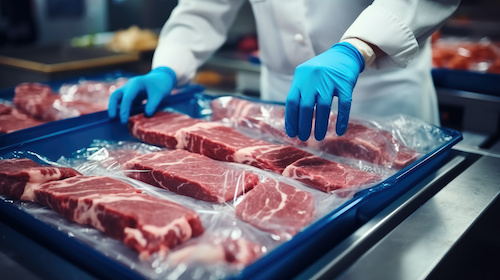
About a quarter of the beef Americans eat passes through a handful of slaughterhouses in southwest Kansas, the corner of the state around Liberal, Dodge City and Garden City that people in the industry call the golden triangle of beef. The plants, owned by National Beef, Tyson Foods and Cargill, employ more than 10,000 people. On Sept. 23, federal immigration agents showed up.
According to The New York Times, local officials got no advance notice and no information afterward about how many people were arrested or who they were. Drivers were pulled over on the main road to one of the packing plants. Shifts had to be rearranged around employees who were either already detained or too afraid to drive to work. “There are people who have proper documentation and can be here legally that are afraid of going out,” Keeley Young, a communications official in Liberal, told the Times.
Within days, the Kansas Livestock Association, Oklahoma Cattlemen’s Association and Texas Cattle Feeders Association issued a joint statement warning that the enforcement actions “will lead to higher beef prices.” They said the raids had delayed shipments of thousands of cattle to processors, cost producers millions of dollars, and disrupted work at feed yards, dairies, grain companies and transportation hubs across three states. The operations are having “a massive chilling effect on the legal, documented, skilled workers that put beef on the table,” they said.
A herd with no slack
The timing couldn’t be worse. The U.S. cattle herd stood at 86.7 million head in January, down from 94.7 million in 2019 and the smallest since the early 1950s. Ground beef hit a record $6.89 a pound earlier this year, and the U.S. Department of Agriculture expects prices to keep climbing. Drought has lingered across Texas, Oklahoma and Nebraska. Tariffs and the war in Iran have pushed up the cost of feed, fertilizer and diesel. The New World screwworm turned up in Texas in June, forcing ranchers to further reduce their herds.
All those factors squeeze the supply of cattle. What the cattlemen are warning about now is the supply of labor at the narrowest point in the chain.
The cattle business fans out across hundreds of miles of ranches and feedlots, but it narrows to a few large processing plants. Four companies control more than 80 percent of U.S. meatpacking. When a kill floor runs short-handed, cattle back up in the feed yards, trucks sit idle, and the costs flow backward to the rancher and forward to the grocery store meat counter. A labor shortage at the chokepoint doesn’t stay local.
Ranchers can’t fix the issues with their herds quickly, but the workforce constraint is an unforced error from Washington.
Who cuts the beef
Meatpacking plants have long been a favorite target for immigration raids. Foreign-born workers made up 45.4 percent of the meatpacking workforce, according to the American Immigration Council, almost 28 percentage points above the average for all industries. Across the entire food system, immigrants account for about 73 percent of agricultural workers.
The federal government knows this. In 2025, the Labor Department warned that immigration enforcement was creating “current and imminent labor shortages” in agriculture that posed a risk of “supply shock-induced food shortages.” Its own estimate held that a 10 percent drop in the farm workforce would cut farm output by 4.2 percent. The government, in other words, was warning about its own policies.
Homeland Security Secretary Markwayne Mullin said ICE was “not conducting worksite operations in Kansas” and was instead targeting people with final removal orders, including violent criminals. That doesn’t change the effect on the labor supply. Enforcement without legal reform removes more than the people agents arrest. The fear it creates keeps coworkers home, too, once they decide it isn’t safe to drive to work.
We’ve tried this before
Every generation or so, the U.S. runs the same experiment in beef country and acts surprised by the result.
On Dec. 12, 2006, federal agents raided six Swift & Co. meatpacking plants in what was called Operation Wagon Train, arresting about 1,300 workers. At the plant in Cactus, Texas, a short drive south of the Kansas plants across the Oklahoma Panhandle, agents detained 297 people, roughly a tenth of the town. Supervisors had to work the line themselves to keep it running.
As Texas Monthly reported, Swift raised wages by 8 percent and still couldn’t find enough American workers to fill the jobs. It turned instead to refugees with legal work authorization from Somalia, Myanmar and elsewhere. Within months, Swift was sold to the Brazilian meat giant JBS. Today, 59 percent of Cactus residents are foreign-born, and the plant still runs on immigrant labor.
The raids changed which immigrants worked the line, at considerable cost, but not the plant’s dependence on them. Then everyone went back to pretending the underlying problem wasn’t there.
The politics catch up with the math
his time, the complaints are coming from some of the administration’s staunchest supporters. Sen. Roger Marshall, a Trump ally in a tough reelection fight, said ICE “needs to coordinate with our local law enforcement.” Nine Republican state lawmakers from southwest Kansas wrote the president saying that “strong borders and fair treatment of our neighbors are not competing goals.” Sid Miller, the Texas agriculture commissioner and a Republican, noted that “these people are not criminals.” Ranchers were already angry about beef imports and market uncertainty before the raids began.
The cattle groups were careful to say they understand federal agencies have to enforce the law. No one in Liberal or Dodge City is calling for open borders. But they’re stuck with a labor-market conundrum: Without immigrants, who is supposed to do the work?
Right now, neither the law nor the lawmakers have an answer. The H-2A visa covers seasonal farm work, and the H-2B is capped and temporary. A packing plant runs year-round, two shifts a day. There’s essentially no legal visa built for the people who staff it. So the industry does what industries do when the law doesn’t match the labor market —it fills the jobs any way it can.
Coordinating raids with local police won’t fix the problem, but a legal pathway that matches labor needs to the available workforce would. In beef country, that means year-round essential-worker visas, employer sponsorship that isn’t limited to college graduates, and a way for people already doing the work to do it legally.